Car Headliner Sagging? Fort Worth Guide to Repair vs Replace, Materials, and What Causes It
Car Headliner Sagging? Fort Worth Guide to Repair vs Replace, Materials, and What Causes It
As a master automotive upholsterer, I see the same issue week after week: a headliner that was perfectly fine yesterday is suddenly "bagging" or resting on the driver’s head today. In the North Texas environment, this isn't just a sign of an old car—it is a predictable result of the extreme climate acting on specific automotive textiles. In the DFW area, your headliner is essentially undergoing a slow-motion chemical steam-cleaning that destroys the bond between the fabric and the roof.
This guide explains the science behind why headliners fail, how they are constructed, and what you need to know before seeking a professional restoration.
1. What Causes Headliners to Sag in North Texas
North Texas drivers deal with a brutal combination of heat, UV exposure, and humidity that acts as a catalyst for material failure.
Extreme Thermal Loads: Inside a closed vehicle, temperatures can soar to 120°C, and in extreme conditions, they can reach as high as 130°C [1, 2, 5, 6]. This intense heat causes the materials to expand and puts immense stress on the internal bonds.
The Hydrolysis Cycle: Relative humidity inside a car can fluctuate from 0% to 100% in daily cycles [1, 2, 5]. Most standard headliners use polyester polyurethane (PU) foam, which has "limited hydrolysis resistance" [2, 3, 5.1.1]. Over time, the combination of heat and moisture causes this foam to chemically break down, losing its structural integrity.
Adhesive Breakdown: Adhesives used in professional lamination must be resistant to heat and fluids to last the life of the vehicle [1]. However, the daily cycle of heating and cooling in the DFW climate eventually degrades these bonds.
UV Penetration: While glass filters some radiation, longer UV rays still penetrate the cabin [1, 6]. These rays are "by far the most damaging to fabrics," contributing to a photo-oxidative attack and the degradation of the underlying structure [1, 6].

2. The Anatomy of a Headliner: Foam Backing, Adhesive, and Fabric Layers
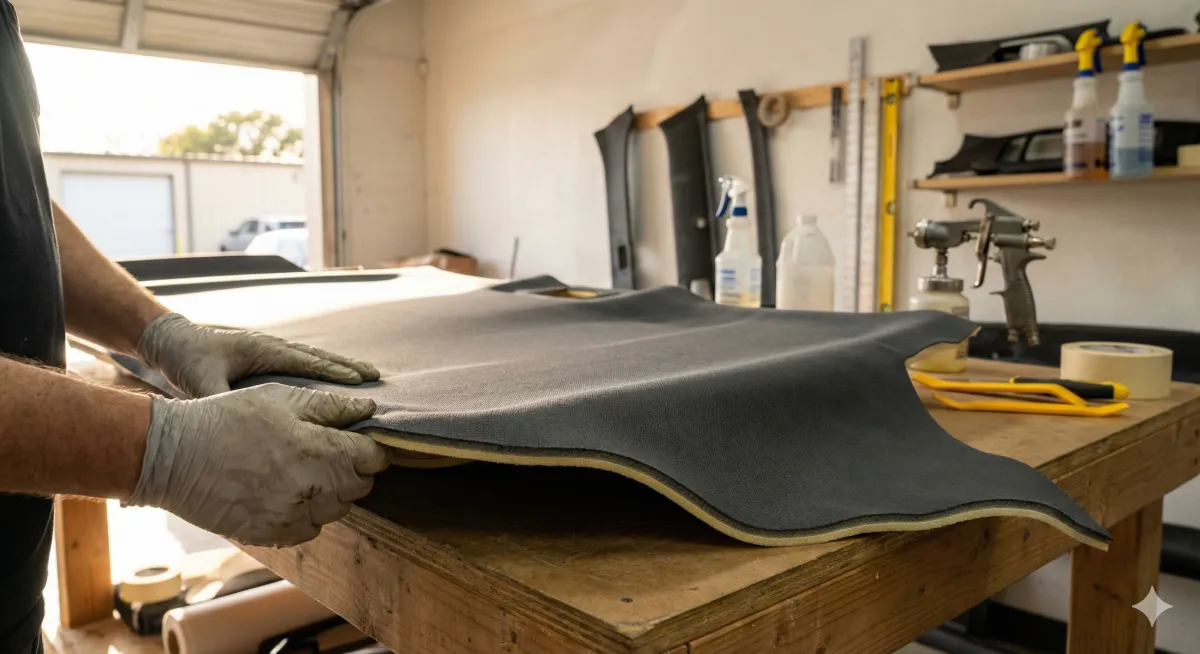
Automotive interiors utilize a specialized "tri-laminate" or "complex" structure designed for comfort and durability [7]. This structure consists of three distinct layers:
Face Fabric: Typically made of Polyester (PES), which is used in over 90% of car interiors due to its "excellent resilience," high tear strength, and resistance to the specific UV wavelengths that penetrate glass windows [1, 2, 3].
Foam Core: A thin layer of Polyurethane (PU) or Polyolefin foam, usually 2–10mm thick [3, 5.1.1]. This layer provides the "soft touch" and essential sound absorption properties required to create a quieter cabin [1, 2, 9, 5.1.1].
Scrim Backing: A lightweight backing (often warp-knitted nylon or polyester weighing 30–90 g/m²) [3]. In professional applications, we look for "queenscord" constructions which provide the necessary stretch control to prevent the headliner from sagging again immediately after installation [2, 3]. It also acts as a "slide aid" during manufacturing [2, 3].
3. Repair vs Replace: Decision Checklist
Before deciding how to handle your sagging headliner, use this checklist to evaluate the damage.
[ ] Minor Peeling: Is the fabric only lifting slightly at the corners? (Field-repairable by a professional—do not attempt to spray glue over existing dirt).
[ ] Localized Staining: Is the issue purely aesthetic, such as a water spot, without any "bagging"? (Potential for cleaning/repair).
[ ] The "Touch Test": When you touch the fabric, does it feel "crunchy," or does an orange powder fall out? (Indicates full foam hydrolysis; professional replacement required).
[ ] Full Sag: Is the fabric draped across the entire roof like a tent? (Replacement required).
[ ] Vehicle Class: Is this an "up-market" vehicle? High-end cars often use more complex materials like natural leather, wool, or artificial suedes like Alcantara, which require specialized technical handling [1, 2, 2.2.2, 2.2.3].
4. DIY Headliner Repair: What Works and What Fails
Many car owners attempt "quick fixes" to avoid a professional shop, but these often lead to permanent damage to the headliner board.
The DIY Boundary If your headliner has begun to "powder"—meaning the polyurethane foam core has disintegrated—simple spray adhesives will fail. These sprays cannot bond to oxidized, crumbling foam [2, 3, 5.1.1].
Common Technical Failures
Adhesion Issues: DIY aerosol sprays lack the heat resistance of professional "hot melt" or solvent-based adhesives [1, 2].
Strike-Through and Handle: Proper lamination requires extreme care to prevent the adhesive from soaking through the fabric—a defect known as "strike-through" [2]. Amateurs often ruin the "soft touch" or "handle" of the material by using too much liquid glue, which makes the fabric feel harsh, stiff, or "cracked" [1, 2].
Creasing: Once a professional-grade adhesive is applied, repositioning the fabric without distorting the texture is nearly impossible for an amateur [1, 3].
Anecdote: Community-standard "quick fixes" like using staples, pins, or tacks may temporarily hold the fabric up, but they do not address the underlying chemical breakdown of the foam.
5. Professional Replacement: Materials and Timeline
When a professional replaces your headliner, the choice of materials determines how long the new interior will last in the Texas heat.
Material Selection
Polyester (PES): The dominant choice for its high tear strength, low water absorbency, and crease resistance [2].
Polyolefin Foam: A superior alternative to standard PU foam. It offers better "ageing properties" and does not cause "fogging"—the oily film that develops on the inside of windshields when cheaper foams break down under heat [2, 5.1.2].
Spacer Fabrics: A modern 3D knitted structure that can replace foam entirely. These offer superior "breathability," "heat conductivity," and "air permeability" [6, 13, 5.3.2]. Because they consist of a single synthetic fiber type, they are more easily recycled and sustainable for eco-conscious drivers [13, 5.3.2].
Knit Nuance: Professionals select specific knit gauges (typically 20–28 gauge) to ensure the material can stretch around the complex "three-dimensional shapes" of modern headliner boards without deforming [1, 4.2].

Cost and Timeline Drivers
Vehicle Complexity: The presence of a sunroof, large overhead consoles, or "roof rail linings" significantly increases the labor required for the removal of the headliner board [4, 34].
Geometric Difficulty: Costs are driven by the complexity of the shapes, such as "sharp concave curves" or pillars, which require intensive labor to prevent delamination [1].
Material Prep: Ensuring the new laminate is "dimensionally stable without any curl" requires specialized equipment and time [2, 3].
6. Requesting a Quote: DFW Checklist
To get an accurate assessment from a professional upholsterer, have the following information ready:
Vehicle Identification: Year, Make, and Model.
Interior Features: Specify if the vehicle has a sunroof, moonroof, or extensive overhead consoles.
Damage Assessment: Note if the fabric is fully sagging, only peeling at the edges, or if the backing has turned to powder.
7. FAQ
Q1: Why is my headliner sagging? It is primarily due to the breakdown of the foam core and adhesive. In the high heat and humidity of North Texas, polyester polyurethane foam undergoes hydrolysis, where it loses structural integrity and delaminates from the fabric [2, 3, 5.1.1].
Q2: Can I just glue it back up? Typically, no. If the foam backing has disintegrated, new glue will only bond to the "dust" of the old foam, causing it to fall again almost immediately [2].
Q3: What is the best material for Texas heat? Polyester (PES) is the industry standard for its UV resistance [1, 2]. For the backing, polyolefin foams or "Spacer Fabrics" provide better long-term ageing and heat resistance than traditional PU foam [2, 13, 5.1.2].
Q4: How long should a professional replacement last? Professional-grade "hot melt" or solvent-based adhesives are engineered to be durable enough to "last the life of the vehicle" under controlled conditions [1, 2].
Q5: Does a sunroof make the job harder? Yes. A sunroof adds significant complexity to the removal of the headliner board and requires additional detail work to ensure the fabric does not lift around the opening [4, 34].
Q6: What is the difference between PU foam and a "Spacer Fabric"? PU foam is a solid sheet of cushioning, while Spacer Fabric is a 3D knit with a hollow center. Spacer fabrics offer much better "air permeability" and "thermal conductivity," making them more breathable and easier to recycle [6, 13, 5.3.2].
Contact the Experts
If your vehicle's interior is showing signs of age or thermal damage, don't wait for the fabric to obstruct your view. Contact My Upholstery Guys today for a professional assessment and high-quality restoration of your automotive headliner. We serve the entire Fort Worth and DFW area with expert technical solutions.
