Car Seat Repair in Fort Worth & Dallas: What’s Fixable, What to Avoid, and When to Call a Pro
Car Seat Repair in Fort Worth & Dallas: What’s Fixable, What to Avoid, and When to Call a Pro
The Reality of Automotive Interior Wear
Driving the DFW Metroplex isn't just hard on your engine; the North Texas sun is a relentless enemy to your upholstery. Whether it's a cracked bolster from sliding into your Ford F-150 after a shift or the "structural collapse" of seat foam that leaves you aching after an hour on I-35, wear is inevitable.
In over 20 years of restoration, I’ve seen every "quick fix" fail because the driver didn't understand the material science underneath them. Most damage is fixable, but the success of that repair depends on the material's DNA and its location. This guide provides the technical framework you need to decide between a repair, a structural rebuild, or a full replacement.

What Usually Fails First (and Why)
Root Causes of Failure
Our Dallas-Fort Worth summers create a "pressure cooker" environment where UV radiation and extreme heat sap the moisture from protective topcoats. This leads to material fatigue, where friction from entry and exit causes the finish to abrade and eventually tear. Use of household detergents further accelerates this by stripping the essential oils required for flexibility.
Material Science
Leather: Most modern vehicles use "Brooklands" type leather, which is engineered, not designed. It features a pigmented polyurethane top coat that forms a continuous homogenous film for maximum durability.
Natural Characteristics: You may notice "neck grain"—textured lines caused by animals stretching to graze—which can become high-wear points. Authentic hides also show veins and healed scars, which maintain structural integrity but require specific care to avoid cracking.
Bonded Leather: This is the "particle board of the leather world," consisting of leather dust and pulp mixed with glue. When it begins to flake, the woven mesh backing is exposed, indicating a total loss of structural integrity that cannot be "painted" over.
Cloth: While resistant to heat, cloth acts as a sponge for contaminants and is highly susceptible to cigarette burns that melt through to the foam.

DIY vs. Pro: The Safety Line You Shouldn’t Cross
Modern seats are safety systems, not just furniture. Side-impact airbags are integrated into seat bolsters and rely on safety thread designed to break at a specific pressure. DIY patches, heavy dyes, or amateur stitching can prevent these "burst seams" from opening, turning a minor repair into a life-threatening hazard.
Electronics add another layer of risk. Heated seat systems use thermostats that interrupt the circuit at 158°F (70°C) to prevent fire. DIYers often puncture these elements with needles or hog rings, or they use insulating "slip-on" covers that cause the elements to overheat.
NEVER use acetone, nail varnish remover, or bleach on leather or vinyl. These aggressive solvents solubilize the finish, meaning they don't just clean the surface—they dissolve the polyurethane topcoat entirely. Once the protective film is dissolved, the underlying hide is exposed to rapid rot and delamination.
The “What’s Repairable?” Decision Guide
Problem
Root Cause
DIY Viable?
Best Professional Fix
Risk of DIY
Cigarette Burn
Ignition/Heat
Yes (Minor)
Fiber blending or panel replacement
Visible scarring; further melting
Peeling/Flaking
Delamination
No
Full panel replacement
Shedding microplastics; total failure
Torn Bolster
Entry Friction
No
Replace with factory-spec leather
Airbag deployment interference
Collapsed Foam
Material fatigue
No
Replacement with Durofoam
Spine absorbs road vibration directly
Seam Split
Thread failure
No
Re-sewing with safety thread
Airbag failure in an accident
Cracked Leather
UV/Heat/Dryness
Yes (Minor)
Specialized fillers and re-dyeing
"Painted" look; peeling in heat
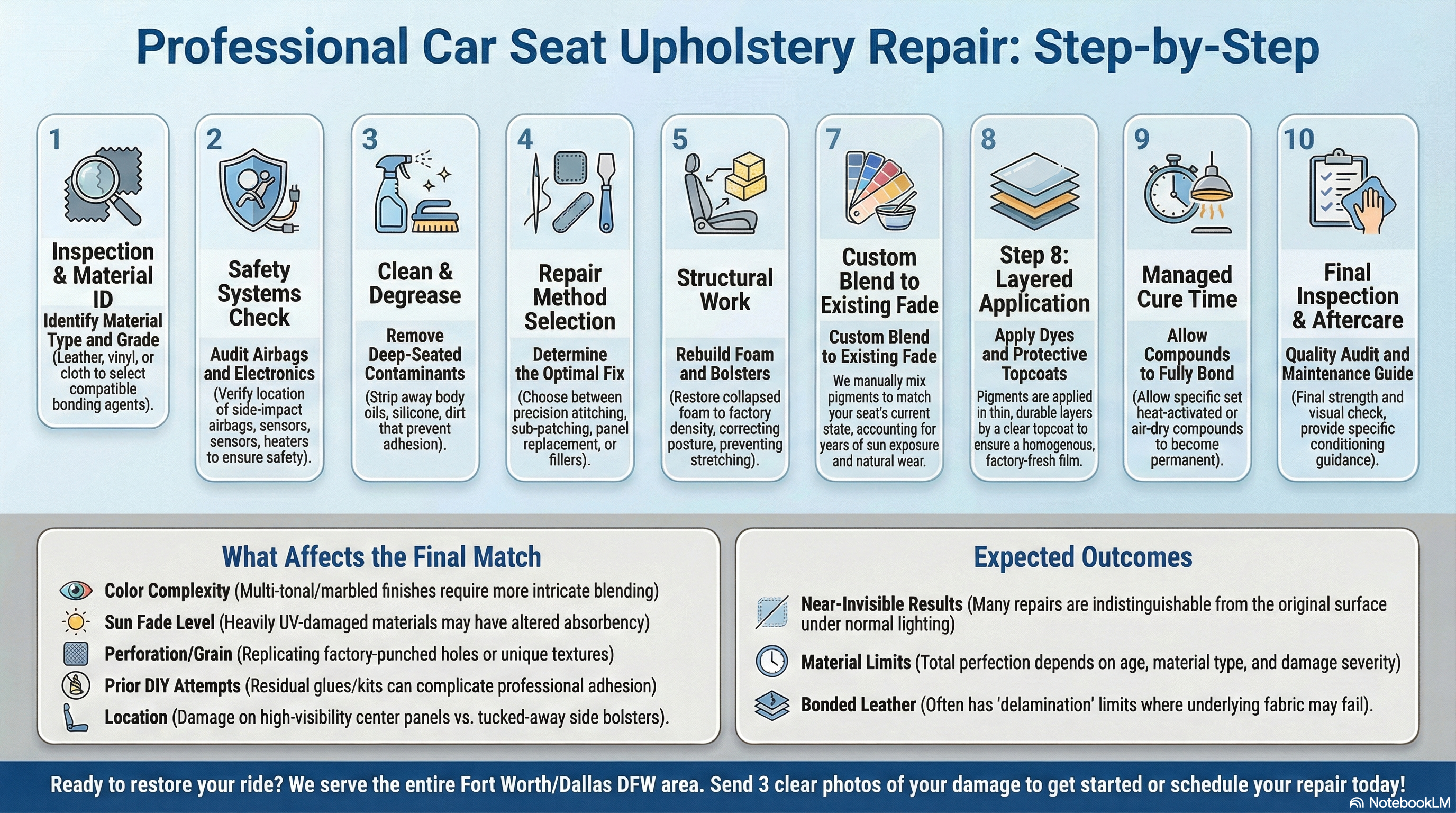
What Professional Car Seat Upholstery Repair Looks Like
Professional restoration is a chronological technical process:
Inspection & Material ID: We determine if you have top grain, a "finished split," or bonded leather to select the right bonding agents.
Protection: We strip the area of oils and contaminants and protect the surrounding cabin.
The Repair: For heavy wear, we perform a panel replacement; for minor cracks, we use specialized fillers that mimic the leather’s natural flex.
Structural Rebuild: If the seat is sagging, we install Durofoam to restore factory-spec spinal alignment and weight distribution.
Color Match & Grain Replication: We use graining molds and color-matching systems to replicate specific luxury finishes like Jag Blue, Mulberry, or Magnolia.
Curing & Sealing: A final topcoat is applied to create a new homogenous film that resists future UV damage.
Repair vs. Replace: A Practical Framework
Knowing when to walk away from a repair will save you thousands in the long run. Use these industry standards:
The Palm of the Hand Rule: If the damage is larger than your palm, a spot repair will likely look "patchy." In these cases, a full panel replacement is required.
Structural Integrity: If you can feel the metal seat frame through the foam, the material has compressed past the functionality point. You are no longer being supported; your body is absorbing the road's vibration.
Bonded Leather Fatigue: If the material is shedding "leather dust" or flakes, it is end-of-life. No amount of dye will fix a material that is literally disintegrating.
Cost Efficiency: Minor burn/tear repairs cost 50–300. If you have multiple failing panels, a full reupholstery (1,000–4,000) provides a better return on investment.
Maintenance After Repair (Ensuring Longevity)
The primary "enemy" of your finish is the physics of dust. Abrasive particles settle into the "valleys" of the grain. When you move, your clothing grabs this grit and rubs it into the finish under force and pressure, acting exactly like sandpaper.
Actionable Habits:
Vacuuming: Use a soft-bristle brush to pull grit out of the grain's valleys. This is more effective than wiping, which can just push dirt deeper.
Cleaning: Use only a damp, lint-free cloth. If you must use a cleaner, ensure it is pH-neutral and designed for automotive topcoats.
UV Protection: Use a non-greasy UV protectant to shield the cabin from the North Texas sun.
FAQ (Frequently Asked Questions)
Can you match specific luxury colors like Suede Green or Biscuit? Yes. We use factory color codes and cross-reference them with the hide’s natural shade differentiation to ensure a seamless blend.
Is peeling vinyl or bonded leather fixable? Generally, no. Since it’s essentially a plastic film glued to a mesh, once it delaminates, any "fix" is purely cosmetic and will peel again within weeks.
Why does worn foam cause back pain? Worn foam causes your hips to sink, which forces your spine out of its natural alignment. This leads to muscle fatigue and chronic pain as your body tries to compensate for the lack of support.
How long do professional repairs last? A professional repair using the correct topcoats can last as long as the original factory finish, provided you keep the "valleys" free of abrasive dust.
Where do I find airbag wiring? Always look for yellow tape, tubing, or connectors. These signify airbag circuits—do not tap into, solder, or move these components during a DIY attempt.
Local CTA: Fort Worth, Dallas, and DFW Metroplex
If you're in Fort Worth, Dallas, Arlington, or anywhere in North Texas, don't guess about the safety of your interior. My shop provides honest, technical assessments for drivers who want their vehicle to feel like it just rolled off the lot.
To get an accurate "repair vs. replace" recommendation, please take three photos:
The Wide Shot: Context of the seat within the vehicle.
The Macro Shot: A close-up of the texture to identify the grain and damage depth.
The Tag: A photo of your vehicle’s year, make, and model.
Reach out today for a consultation. We’ll help you drive comfortably—and safely—again.
My Upholstery Guys
(817) 623-0589
6925 E Lancaster Ave Ste. B, Fort Worth, TX 76112
