
Home Furniture Vinyl Cracking and Peeling: Care, Repair, and When to Reupholster in Fort Worth
Home Furniture Vinyl Cracking and Peeling: Care, Repair, and When to Reupholster in Fort Worth
1. Introduction: The DFW Vinyl Dilemma
In my years at the shop here in Fort Worth, I’ve seen countless sofas and recliners die a slow death because of the unique Texas environment. Whether it’s that intense afternoon sunlight through west-facing windows or the cycling humidity, vinyl furniture in DFW takes a beating. You’ll notice it first when the material feels tacky to the touch or starts peeling away like a bad sunburn. At My Upholstery Guys, we know that once you see these signs, a chemical clock is already ticking. Understanding the science of your furniture is the first step in saving it.
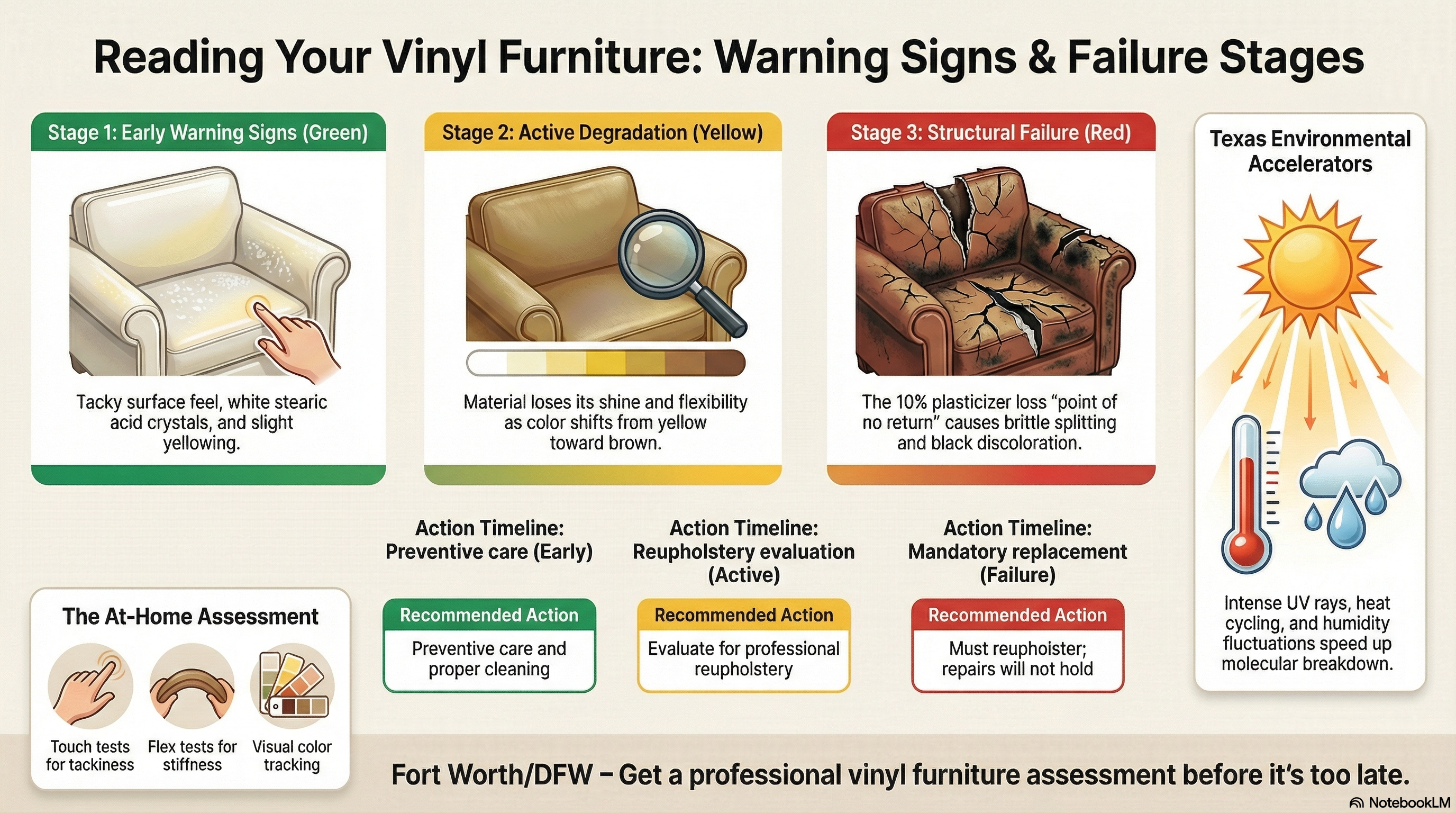
2. What Causes Vinyl to Crack and Peel
Vinyl, or plasticized PVC, isn't a single solid material; it’s a delicate balance of polymers and additives. When that balance shifts, the material fails.
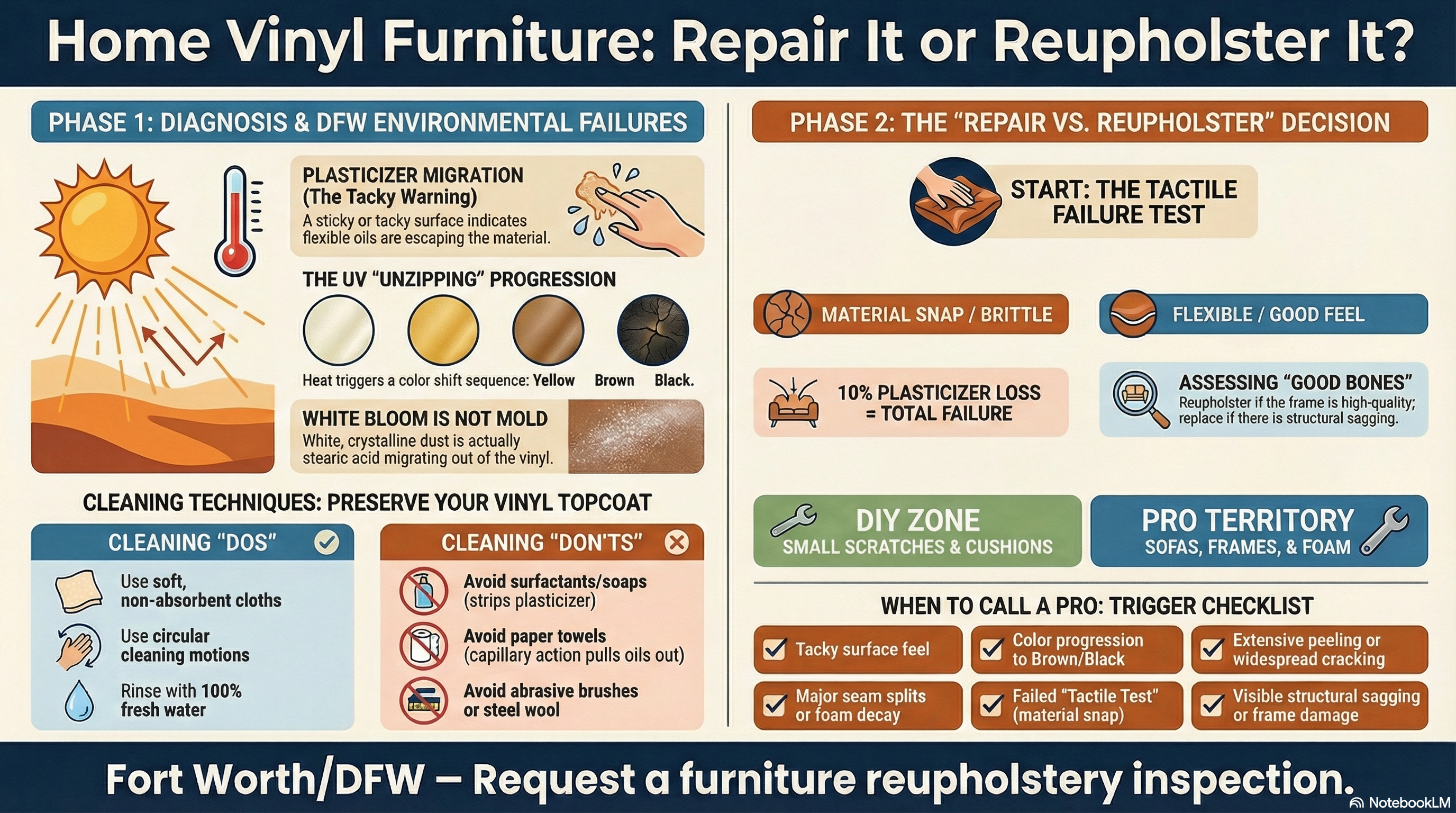
Plasticizer Migration: To make PVC flexible, we add DEHP plasticizers. These molecules are not chemically bound to the polymer (Shashoua, 2001). Over time, they move toward the surface, creating a "tacky" feeling. This migration is the direct precursor to embrittlement; once the plasticizer leaves the core, the vinyl becomes brittle and cracks (Shashoua, 2001).
The "Unzipping" Process: Texas heat and UV exposure trigger a reaction called dehydrochlorination, or "unzipping" (Shashoua, 2001). This is the visual confirmation of the polymer chain breaking down, causing your vinyl to change color from yellow to brown and eventually black (Shashoua, 2001).
White "Bloom" (Stearic Acid): Homeowners often mistake white crystals on their furniture for mold or dust. In reality, this is often Stearic Acid—a lubricant used in manufacturing that migrates to the surface when the environment changes (Shashoua, 2001). High humidity can also lead to the formation of white phthalic acid crystals (Shashoua, 2001).
3. Routine Cleaning That Prevents Premature Failure
Most folks accidentally accelerate the death of their vinyl by cleaning it too aggressively. To extend the life of your piece, you have to protect the plasticizer film.
Approved Methods: The secret to longevity is reducing air agitation around the piece, which slows the evaporation of vital oils (Shashoua, 2001). When cleaning, use soft, non-absorbent cloths.
Warnings: Never use surfactants or soaps. These chemicals emulsify and strip away the protective plasticizer film, causing the material to crack much faster (Shashoua, 2001).
Pro-Tip: Beware of using absorbent tissues or certain paper towels. These can actually create a "capillary action" that literally sucks the plasticizers out of your vinyl and into the paper, leaving the furniture dry and prone to peeling (Shashoua, 2001).
4. DIY Repair Limits: When a Patch Kit Works and When It Doesn’t
I always tell my neighbors: DIY is for cosmetics; professionals are for longevity.
DIY Friendly
Professional Required
Small items like outdoor cushions (Angi).
Large furniture like sofas or sectionals (Angi).
Minor surface scratches or snags (Angi).
Structural repairs to frames, springs, or joints (Angi).
Small, non-structural seam splits (Angi).
Replacing worn webbing or internal foam (Angi).
5. Repair vs. Reupholster vs. Replace: The Decision Framework
When you're staring at a peeling recliner, use this professional framework to decide your next move:
The 10% Failure Rule: If a material has lost 10% of its original weight through plasticizer loss, it has fundamentally changed character and "failed" (Shashoua, 2001). If it feels stiff and brittle, it cannot be saved with a "fix."
The "Bones" Test: If the frame is high-quality but the vinyl is tacky, reupholstery is a smart investment (Angi).
The Hidden Costs: Always budget for more than just fabric. Expect Cleanup/Disposal fees for old materials and Delivery/Pickup fees ranging from 50–150 per trip (Angi).
Average Reupholstery Costs by Piece Type | Piece Type | National Average (Angi) | Local DFW Expectations | | :--- | :--- | :--- | | Normal Range | $370 – $1,146 | Competitive Market Rates | | Dining Chair | $150 – $600 | Includes basic padding | | Armchair | $300 – $700 | Standard labor | | Recliner | $600 – $2,000 | Complex mechanisms | | Sofa | $800 – $2,500 | 60" to 90" standard |
6. Professional Reupholstery: Materials, Foam, and Timeline
A professional job at our shop involves a full teardown and rebuild.
Size and Complexity: Size is a major driver; large pieces (60" or wider) typically start at $1,200 (Angi). Added complexity like tufting, piping, or decorative nailheads adds significant labor time and cost (Angi).
Material Selection: Synthetic vinyl ranges from 10–110 per yard, whereas genuine leather—which requires more skill to handle—ranges from 50–250 per yard (Angi).
The "Sinking" Fix: If your cushions are flattening, we replace the foam. This adds 50–200 per seat but restores the original comfort (Angi).
Timeline: While we can knock out a dining chair in 2–3 hours, a full sofa typically requires several days to a week due to the labor complexity of tufting and piping (Angi).
7. Quote-Prep Checklist & FAQ
Professional Quote Checklist
To help us give you the most accurate estimate, please have the following ready:
Clear Photos: Include the full piece and close-ups of the "unzipping" or peeling areas.
Dimensions: Note the furniture type and its approximate width and height.
Usage History: How long have you owned it? Is it exposed to direct Texas sun or high-traffic use?
Frequently Asked Questions
Can you reupholster over old material? While it can save a few dollars in some cases, you must use a darker color to prevent the old pattern from showing through. However, this is usually not possible if the original surface is leather (Angi).
Is it easy to DIY a large sofa? No. Large pieces require professional tensioning and frame handling. Mistakes on high-end materials like leather can be very costly (Angi).
What is the "tacky" feeling on my vinyl? This is plasticizer migration. The softening agents are moving to the surface, which is the first sign that the material is beginning to fail (Shashoua, 2001).
How long does a professional sofa restoration take? Typically, a full sofa takes several days to a week depending on the complexity of the design (Angi).
Does reupholstery include frame repair? Standard labor covers minor fixes, but significant structural work on joints or springs can add 50–500 to the total bill (Angi).
What are the most durable fabric options? Performance fabrics and mid-range synthetics are highly durable and often more cost-effective than premium leathers (Angi).
8. Call to Action (CTA)
If your favorite chair is starting to feel tacky or you’re seeing the dreaded "unzipping" color changes, don't wait for the frame to be compromised. My Upholstery Guys is here to help Fort Worth and DFW residents restore their cherished pieces. Contact us today for a professional inspection and a detailed quote to bring your furniture back to life.
