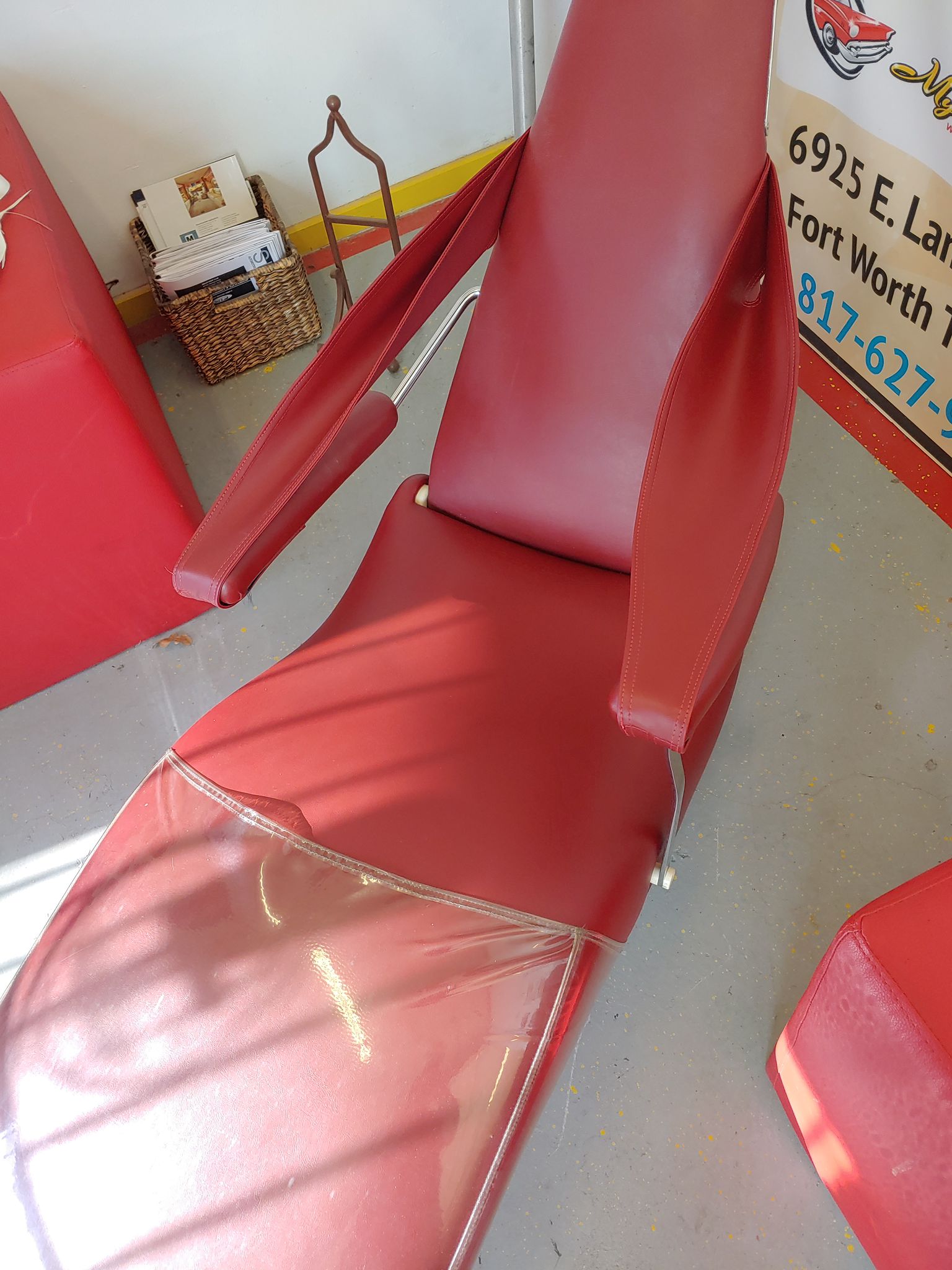
Leather Furniture Repair: What You Can Fix, What You Shouldn’t, and When to Call a Pro

Leather Furniture Repair: What You Can Fix, What You Shouldn’t, and When to Call a Pro
There is a specific, heart-sinking moment every leather owner knows: the day you notice your favorite couch—once a smooth, supple masterpiece—is starting to look like an arid desert landscape. Whether it’s the frustration of jagged cat scratches, sagging cushions that have lost their "loft," or color that has faded under the afternoon sun, leather damage feels like a total loss of a high-value investment.
As a Senior Master Upholsterer with decades in the shop, I see these issues daily. Most homeowners are caught between risky "miracle" DIY hacks they found on social media and the fear of a massive replacement bill. This guide is your no-nonsense decision framework for leather furniture repair. I’ll tell you exactly what you can safely maintain at home, which damage types require a specialist's chemistry, and what to expect when you call in a pro for leather couch repair.
--------------------------------------------------------------------------------
What Leather Damage Really Means
Leather fails because it is a natural material governed by complex chemistry. Over time, a hide loses its delicate balance of fat and water. When leather dries out, it becomes porous and begins to absorb what it touches—specifically body oils and hair oils from your skin. These oils act as an abrasive, breaking down the protective surface coatings and eventually destroying the protein bonds that hold the leather fibers together. This is the root cause behind most leather crack repair needs.
External factors like UV light and proximity to heat sources (radiators or fireplaces) accelerate this drying process. However, some failures start at the factory.
Bonded Leather: This isn't true hide. It is a "pulp" of leather scraps and fibers held together by high-strength adhesives. When body oils hit those adhesives, they dissolve, causing the material to peel away from its fabric backing in sheets. This is a total material failure.
Top-Grain/Finished Leather: Even high-quality leather can suffer from "manufacturer stretching issues." If a tannery fails to properly stretch the hide before applying the dye and protective topcoat, the leather will eventually stretch more than the finish can handle. The result? The coating cracks and delaminates because it simply can’t keep up with the hide’s natural give.
--------------------------------------------------------------------------------

DIY-Friendly Leather Fixes (Low-Risk Maintenance)
While major restoration belongs in my shop, you can protect your leather sofa repair investment with safe, professional-grade maintenance.
Cleaning: Use a pH-neutral cleaner (specifically pH 4-6) to protect the protein bonds. Master’s Tip: Use warm distilled water (or deionized water for Aniline to avoid mineral rings) to increase cleaning effectiveness. Apply to a white cotton cloth first—never spray the leather directly.
Conditioning: Apply quality conditioners every 3–6 months. Use a circular motion with a clean, white cotton cloth to replenish natural oils.
Scuff Management: For light surface scuffs on "pull-up" leathers, rub the area with your fingertips. The warmth of your skin releases natural oils that help blend the mark away.
Kits: Only use DIY kits for pinpoint surface scuffs on pigmented leather. Anything larger requires professional texture matching.
The Gold Standard: Use a dedicated CCP (Cleaner, Conditioner, Protector) system and Ink & Stain Remover Sticks designed specifically for leather chemistry.
The Pro’s Warning: Household Disasters to Avoid
If you value your furniture, keep these items far away from it. I’ve seen more hides ruined by "hacks" than by actual use. Never use:
Acetone or Alcohol: These will strip the factory finish instantly.
Magic Erasers: These are micro-abrasives. You are effectively sanding off your sofa’s protection.
Saddle Soap or Mink Oil: Too harsh for modern upholstery; they cause gummy buildup.
Hairspray or "Amazon Dyes": These contain chemicals that dissolve topcoats and create blotchy, permanent stains.
Olive Oil: It will go rancid inside your cushions.
--------------------------------------------------------------------------------
Damage Types and the Best Fix: The Ultimate Decision Guide
Problem
Likely Cause
DIY?
Best Professional Solution
Risk if You DIY
Cat Scratches (Swiping)
Long slashes from running
No
Sanding, synthetic filler, texture matching, and recoloring.
Improper sanding ruins the hide permanently.
Cat Scratches (Kneading)
"Making biscuits" (pilling)
No
Trimming fibers, leather binding glue, and micro-filling.
You’ll likely puncture the hide or create "fuzzy" spots.
Deep Crack
Dryness/Loss of oils
No
Synthetic filling and custom re-dyeing.
Filler won't bond to oily leather; it will pop out.
Faded Color
UV Sunlight/Heat
No (If >30%)
Professional leather color restoration.
Aniline is nearly impossible to DIY match; results look blotchy.
Peeling (Bonded)
Adhesive/Material failure
No
Full panel replacement.
Fillers have nothing to "bite" onto and will peel again.
Sagging Seat
Foam replacement
No
High-density foam restoration and spring repair.
Improper stuffing distorts the leather ("puddling").
Ink/Stains
Pens or spills
Maybe (Fresh)
Ink stick followed by CCP. Stop if it doesn't work instantly.
Rubbing too hard dissolves the color and topcoat.
--------------------------------------------------------------------------------
When You Should Call a Pro
You can handle the dusting, but you cannot handle structural or chemical failure. Call a pro if you see:
Tears or Seam Splits: If the damage goes through the hide or the stitching is separating, it’s a structural failure.
Widespread Peeling: Especially if the color is transferring onto your clothes.
Sticky Topcoat: If the leather feels greasy or "gummy," the factory finish has chemically failed.
Collapsed Cushions: If you are "bottoming out," you need professional leather cushion repair and foam restoration.
High-Value Antiques: These require specialized knowledge of Aniline vs. Pigmented finishes to preserve value.
The Honest Reality of Bonded Leather
If your bonded leather is peeling, be prepared for me to tell you it’s time to replace the furniture. Because the base material is essentially paper and glue, professional repairs are usually temporary. We can replace a panel, but we can't "fix" a failing pulp.
--------------------------------------------------------------------------------
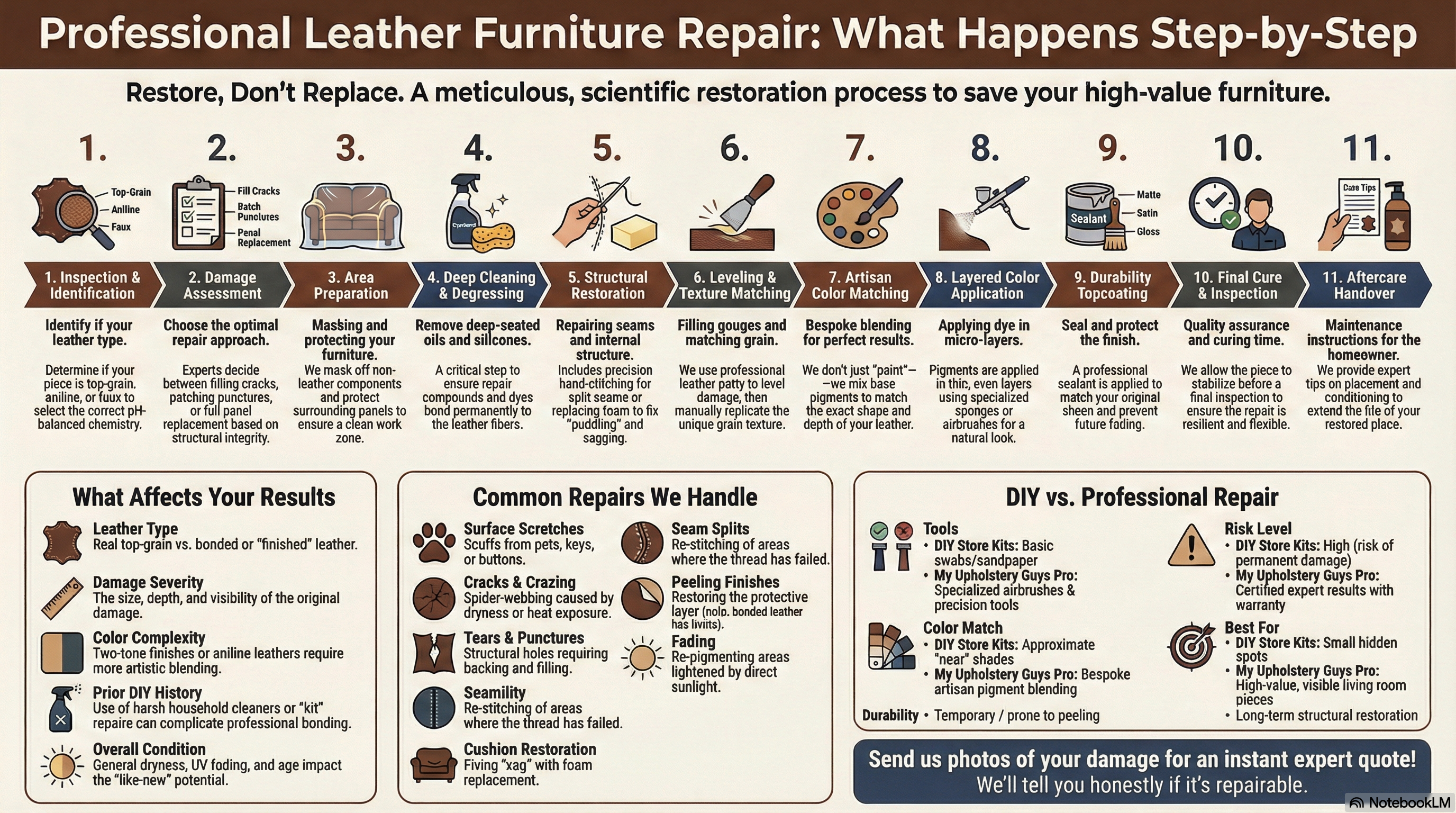
What Professional Leather Furniture Repair Actually Includes
When you send a piece to my shop, you are getting a multi-step chemical restoration, not a "touch-up":
Inspection: We identify the hide (Aniline, Pigmented, or Nubuck) to choose the right chemistry.
Cleaning & Degreasing: We remove embedded body oils using specialized agents like Odorless Mineral Spirits. Trying to fix oily leather is like "trying to stick a band-aid onto an oily arm"—it simply won't hold.
Repair & Fill: We use professional-grade synthetic compounds and grain-matching tools to mimic the natural texture.
Color Matching: This is an art. We custom-blend pigments and use an airbrush to blend the new color seamlessly.
Sealing: We apply a protective topcoat and allow proper curing time for durability.
--------------------------------------------------------------------------------
Repair vs. Replace: A Practical Framework
Ask yourself these questions before committing to a leather chair repair:
Leather Type: Real top-grain is worth the investment. Bonded is often a "sunk cost."
Frame Quality: Is the "skeleton" solid? A kiln-dried hardwood frame is always worth saving.
The 30% Rule: For leather color restoration, if more than 30% of the surface is faded or failed, a full professional re-dye may be less cost-effective than replacement.
Sentimental Value: Heirloom pieces merit restoration regardless of minor costs.
Cost: Minor scuff repair is a fraction of the leather repair cost for full reupholstery.
--------------------------------------------------------------------------------
Maintenance After Repair
Once your piece is restored, keep it that way with these shop rules:
Targeted Weekly Wiping: Use a soft, damp cloth on "high-contact" areas like headrests and arm covers where perspiration and oils accumulate.
Strategic Placement: Keep the piece 2 feet away from radiators and out of direct "sun-strike" areas.
Barrier Protection: Use professional-grade "Protector" creams every 4 months to create a barrier against body oils.
--------------------------------------------------------------------------------
FAQ
Can cracked leather be repaired? Yes, if caught before it turns into a full tear. We use synthetic fillers and custom re-dyeing to stabilize the hide.
Can peeling leather be repaired? Only if it is the finish peeling on real leather. If the "pulp" of bonded leather is failing, you need panel replacement.
Is it better to reupholster than repair? Repair is faster and cheaper for surface issues. Reupholstery is for structural failure or total leather neglect.
Can you fix sagging leather cushions? Absolutely. Professional high-density foam replacement removes "puddling" and makes the leather look taut again.
How long does leather repair last? With proper CCP maintenance, a professional repair can last for years of daily use.
Can you match my leather color? Yes. We custom-blend pigments to match your specific dye lot and current level of fading.
--------------------------------------------------------------------------------
Preserve Your Investment Today
Don't let a small scratch turn into a total replacement. If you are in the Fort Worth / DFW area, stop searching for a "furniture upholstery shop near me" and talk to a master craftsman.
[Send us photos of your damage today for a free assessment and an expert quote from the guys at the shop!]
My Upholstery Guys
(817) 623-0589
6925 E Lancaster Ave Ste. B, Fort Worth, TX 76112
