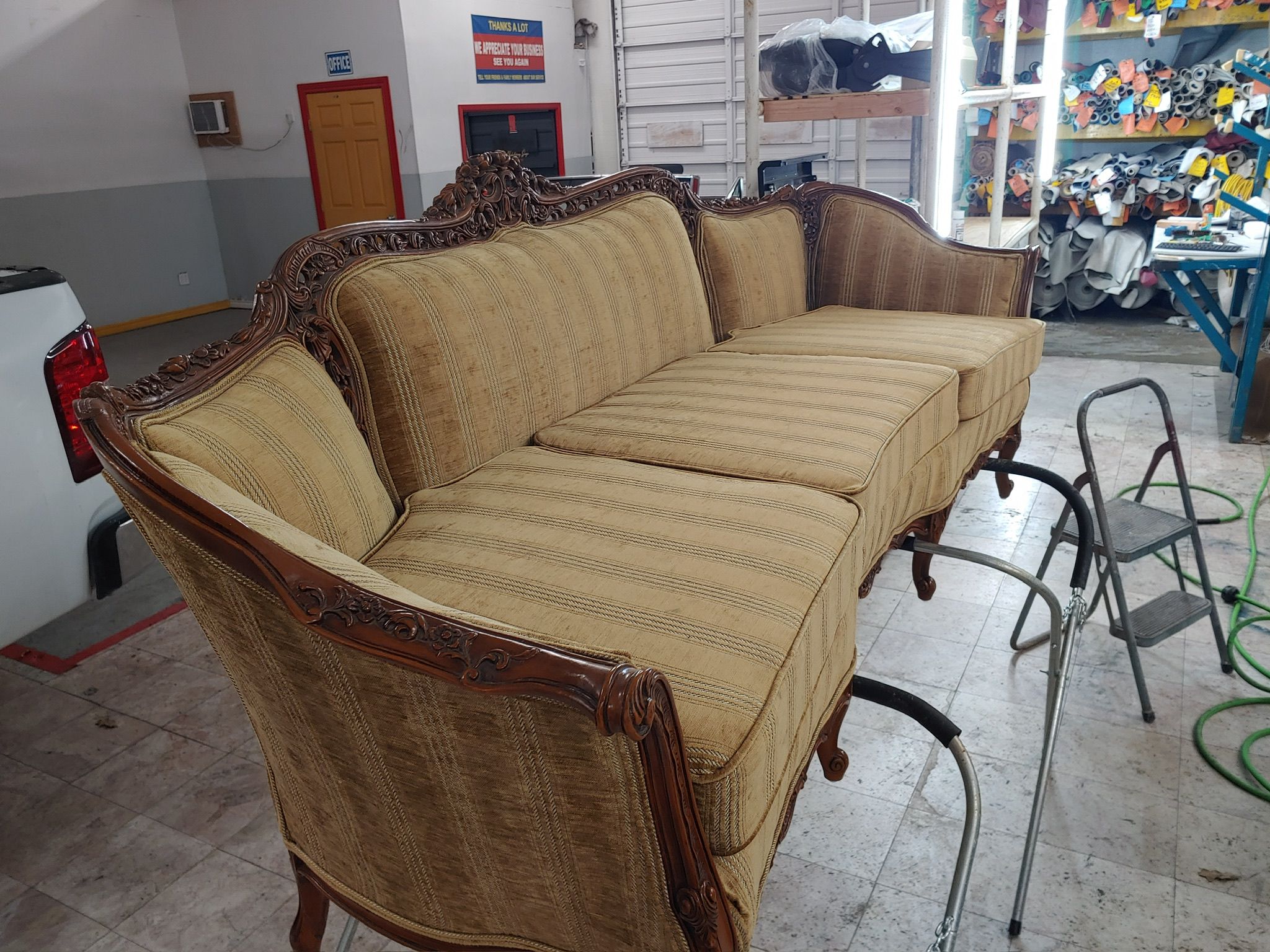
Upholster or Replace?

Clean, Reupholster, or Replace? The 2025 Cost & Decision Guide for DFW
That favorite sofa or armchair—the one with the perfect spot—is starting to look tired. Maybe it's stained, the fabric is worn, or the cushions have lost their support. You're facing a common dilemma: is it time to clean it, give it a new life with reupholstery, or simply replace it? While the average sofa has a lifespan of seven to 15 years, a truly well-built piece can last for generations with the right care. In my decades of work here in Fort Worth, I've seen firsthand how a quality frame can outlast its fabric three or four times over.
This guide provides a clear, practical framework to help you decide whether professional cleaning, full reupholstery, or complete replacement is the smartest financial and practical choice for your situation.
Your Quick Decision Framework
Before diving into the details, this section provides the tools for a fast assessment of your furniture's future.

Start Here: Your 5-Minute Decision Checklist
Answer these simple questions to get a quick indication of your best path forward.
Is the frame solid and heavy? Try lifting one front corner a few inches. If the other front leg lifts almost immediately, the frame is rigid and likely well-made. If it twists or wobbles, that's a red flag.
Does the piece have significant sentimental or monetary value? If it's an heirloom or a high-end brand, saving it is often the best choice.
Are the cushions sagging or uncomfortable? If the frame is good, this is often a simple fix involving new foam or refilling.
Is the fabric torn, frayed, or deeply stained? Cosmetic issues on a high-quality frame are the primary reason for reupholstery.
Is the estimated cost of reupholstery close to or more than buying a comparable new piece? If the underlying quality isn't exceptional, replacement might be more cost-effective.
Clean vs. Reupholster vs. Replace: At a Glance
Factor
Professional Cleaning
Full Reupholstery
Buying New
Cost Range (2025)
Significantly lower than reupholstery, typically a few hundred dollars, making it the most budget-friendly option for cosmetic improvements.
Average $600 - 4,000** for a couch. Can exceed **2,000 for a large sofa.
$800 - $5,000+ for a comparable new piece.
Time to Complete
A few hours to a day
2-6 weeks
1 day to 12 weeks for delivery
Lifespan Extension
N/A (restores appearance)
10-20 years
Varies by quality (Average sofa is 7-15 years)
Best For...
Surface stains, pet hair, lingering odors, and allergen removal.
High-quality frames with worn fabric, sagging cushions, or when you want total customization.
Furniture with a broken or low-quality frame (e.g., particleboard), or when reupholstery costs approach replacement cost.
When It’s a Waste of Money
Deep-set stains, torn or frayed fabric, and structural issues like sagging springs.
Low-quality frames (particleboard, soft pine), or if a comparable new piece is cheaper.
If you have a high-quality, sentimental piece with a solid hardwood frame that just needs a refresh.
Is Your Furniture Actually Worth Saving? The Quality Test
The single most important factor in the reupholstery decision is the underlying quality of the piece. A beautiful new fabric is wasted on a frame that's destined to fail. Here’s how to assess the "bones" of your furniture like a professional.
1. The Frame: The Skeleton of Your Sofa
As an upholsterer, the first thing I inspect is the frame. It's the skeleton of your sofa, and without good bones, any work I do is just a temporary facelift. The gold standard is a frame made from kiln-dried hardwood like oak, maple, or beech, which has had its moisture removed so it won't warp or crack. You should avoid frames made from particleboard, chipboard, or softwoods, as they are not built to last.
Equally important is the joinery. The best methods are wooden dowels, mortise-and-tenon joints, and corner blocks that are both glued and screwed into place. These techniques ensure the frame remains square and rigid under years of use.
Here's a trick of the trade: don't just ask about the frame, look for yourself. Peek underneath for those corner blocks. If you see them glued and screwed, you're looking at a piece built to last. Now, try to wiggle the arms and back of the sofa. Is there any give or flex? A high-quality, well-joined frame will feel like a single solid unit with no movement.
2. The Suspension: The Source of Your Support
The suspension system is what keeps you from sinking through the cushions to the floor. The "gold standard" is the eight-way hand-tied spring system, where each spring is individually tied to the frame in eight directions, offering exceptional support and durability. A more common but still very good and durable option are sinuous springs (or "S-springs"), which are S-shaped coils that run from the front of the frame to the back.
You can test the springs yourself. Remove the seat cushions and press down firmly on the springs. Do they feel tightly coiled and supportive, or do they sag easily and make metallic creaking noises? Sinuous springs should be close together; if you can fit more than a few fingers between them, the support will be weak.
3. The Cushions: Decoding Foam & Fillings
Cushion quality determines both initial comfort and how well your sofa keeps its shape. To understand it, you need to know two key terms:
Density is a measure of durability. Measured in pounds per cubic foot (lbs/ft³), it tells you how much foam is packed into a space. Higher density foam lasts longer. A base foam with a density of 2.0 lbs/ft³ or higher is considered "high-end" and will resist body indentations for years.
Firmness is a measure of feel. Measured by ILD (Indentation Load Deflection), this number indicates how much force is needed to compress the foam. A higher ILD number means the foam feels firmer.
Think of it this way: Density is about durability, and firmness is about feel. A high-density, low-firmness foam will feel soft but will keep its shape for years. A low-density, high-firmness foam might feel supportive in the store but will develop permanent body impressions much faster. That's why I always prioritize density for my clients' core cushions. For cushions that bounce back quickly and maintain their shape, High-Resilience (HR) foam is an excellent choice for its durability.
4. The Fabric: Beyond Just Looks
Let's clear up the biggest misconception I hear from homeowners: fabric grades have almost nothing to do with durability. It's a pricing system. A "high-grade" silk will shred in a year with kids and pets, while a "lower-grade" performance polyester will look great for a decade.
True durability comes down to an industry test measured by abrasion, like Wyzenbeek double rubs or Martindale cycles, which simulate the wear and tear of someone sitting down and getting up over and over. When choosing a new fabric, ask about its abrasion rating. Some common fabrics and their typical lifespans include:
Performance Polyester: 5-10 years
Leather: 5-15 years
The Real Cost-Benefit Analysis (2025 Data)
Once you've determined your furniture has good bones, the next step is to weigh the costs.
What Drives Reupholstery Costs in 2025?
Several key factors influence the final price of a reupholstery project. Understanding them will help you budget accordingly.
Labor: This is often the largest portion of the cost. The complexity of the piece significantly impacts the price; features like tufting, skirts, or recliner mechanisms require more time and skill from the upholsterer.
Fabric: The cost of upholstery fabric varies widely, from $30 to $350 per yard. The amount needed depends on the size of your furniture and the pattern of the fabric.
Cushion/Padding Replacement: If your cushions are sagging, new high-quality foam is a must. This can cost between 50–200 per seat.
Structural Repairs: If the springs need re-tying or the frame needs reinforcement, these repairs will add to the overall project cost.
Two Real-World Examples
Example A: The Mid-Quality Couch with Pet Problems
Problem: A homeowner has a 5-year-old microfiber sofa. The frame is decent, but not high-end hardwood. The main issues are stubborn pet odors and several noticeable stains on the cushions that haven't come out with home cleaning.
Analysis: A professional cleaning might remove the odors and some stains, but it won't fix underlying wear or guarantee removal of deep-set marks. The average cost to reupholster a couch is around $1,800. Factoring in new foam, the total cost could easily approach or exceed the price of a brand-new, comparable mid-quality sofa.
Verdict: Reupholstery is likely not a smart investment here. The best options are to first try a professional deep cleaning. If that fails, replacement is the more financially sound choice.
Example B: The High-Quality Frame with a Worn-Out Look
Problem: A family owns a 15-year-old sofa that was a significant investment. It has a heavy, kiln-dried hardwood frame and the springs are still supportive. However, the original fabric is faded from sunlight and worn thin on the arms, and the seat cushions have become flat and uncomfortable.
Analysis: This sofa is the ideal candidate for reupholstery. Its "bones" are excellent—far superior to most new furniture available in the mid-price range. The cost to reupholster and replace the cushion foam is a sound investment because it will restore a high-quality piece and extend its life for another 10 to 20 years.
Verdict: Reupholstery is a very smart investment. It will restore a valuable, well-built piece of furniture for less than the cost of buying a new one of comparable quality, while also allowing for complete customization of the look.
Your Final Decision: Signs for Each Path
Here are the key indicators to guide you toward the right choice.
Signs Cleaning Is Your Best Bet
The furniture has lingering pet odors or a general stale smell.
Your sofa's color looks dull and lifeless, but the fabric itself is intact.
There's a buildup of stubborn pet hair in the weave of the fabric.
Family members are experiencing allergy flare-ups, which can be caused by allergens trapped in the upholstery.
Signs Reupholstery Is a Smart Investment
The furniture has a solid, heavy hardwood frame that feels rock-solid.
You sink into a lumpy, unsupportive seat, even though the frame feels rock-solid.
The fabric is torn, badly faded, or permanently stained, but the piece itself is high-quality.
The furniture has significant sentimental value and you want to preserve it for future generations.
Signs It's Time to Say Goodbye and Replace
The frame is wobbly, cracked, or made of low-quality materials like particleboard.
The cost of reupholstery (including fabric and any necessary repairs) is more than the price of a comparable new piece.
The springs are broken, bent, or sagging beyond a simple repair, indicating a failing support system.
A Note on Maintenance and Lifespan
Whether your furniture is newly reupholstered or brand new, proper care is essential to extending its life.
For Fabric: Vacuum upholstery weekly using low suction to remove dust and debris. Keep furniture out of direct sunlight to prevent fading. For spills, act immediately by blotting with a clean cloth—never scrub, as this can damage the fibers.
For Leather: Dust weekly with a soft, damp cloth. To prevent drying and cracking, clean and condition the leather 3-4 times per year, paying special attention to areas with frequent body contact. Keep leather furniture out of direct sunlight.
Your Fort Worth Upholstery Experts
Making the right choice between cleaning, reupholstering, and replacing can save you hundreds, or even thousands, of dollars while preserving the quality furniture you love. If you're still unsure, the best next step is to get a professional opinion.
At My Upholstery Guys, we can help you assess the quality of your piece and give you a clear, honest recommendation based on your goals and budget.
Ready for an expert opinion? Send us a few photos and the basic measurements of your piece, and we’ll give you a preliminary quote. For a precise estimate, we’re happy to schedule a professional inspection at your Fort Worth-area home or business.
Frequently Asked Questions (FAQ)
Q: How much does it cost to reupholster a couch in 2025?
A: The cost to reupholster a couch averages 1,800**, but typically ranges from **600 to $4,000 depending on the piece's size, the fabric you choose, and the complexity of the labor involved.
Q: How long does the reupholstery process take?
A: The entire process, from selecting fabric to the completed project, typically takes two to six weeks.
Q: Can reupholstery get rid of pet odors and smoke smells?
A: Yes. Reupholstery is a guaranteed way to eliminate stubborn odors because it involves completely removing the old fabric and padding that have absorbed the smells over time.
Q: Is it worth replacing the foam in my cushions?
A: Absolutely. If your frame is in good condition but your cushions are flat or unsupportive, replacing the foam is a critical part of the reupholstery process. It fully restores comfort and typically costs around $50 to $200 per seat. In my opinion, replacing the foam is non-negotiable during a quality reupholstery job. It's the single most effective way to make a 15-year-old sofa feel brand new again.
Q: Do fabric grades mean a fabric is more durable?
A: Not necessarily. Fabric grades are mainly a pricing system based on factors like the type of material and the complexity of the weave. A lower-grade performance fabric can easily be more durable than a high-grade delicate fabric like silk. This is why you should always ask your upholsterer about a fabric's 'double rub' count, not its grade, to determine how it will stand up to your family's lifestyle.
Q: My leather is cracking. Can it be saved?
A: It depends on the severity. While reupholstery is always an option for extensive damage, minor cracking is often a sign that the leather is drying out. A regular care routine, including cleaning and conditioning 3-4 times a year, can prevent this and maintain the leather's health.
