My Upholstery Guys · Fort Worth, TX · Motorcycle Upholstery
Motorcycle Seat & Backrest Upholstery: Thread, Vinyl, and Pan Repair in Fort Worth/DFW
Motorcycle UpholsteryIn the Dallas-Fort Worth Metroplex, a motorcycle saddle is subjected to a "weathering cycle" that ranks among the most punishing in North America. The combination of triple-digit summer heat, high UV indices, and sudden, torrential rain causes factory materials to fail prematurely.
Prolonged exposure to this environment causes vinyl to dry out and turn brittle, eventually leading to surface cracking that allows moisture to reach the internal foam core. For riders of heavyweight cruisers like Harley-Davidson, Indian, and the Honda Gold Wing, maintaining the structural and mechanical integrity of the seat is a requirement for long-distance safety and ergonomic support.
What Fails First on Motorcycle Seats in North Texas
The primary failure points for DFW riders are surface brittleness, foam saturation, and internal hardware corrosion. Once UV damage compromises the vinyl, the seat begins "soaking up trouble." This moisture ingress leads to a cascade of problems:
Failure 1 — Foam Breakdown
Water makes foam soggy and spongy, resulting in a loss of density and the formation of ergonomic lumps that cause rider fatigue and numbness on longer hauls.
Failure 2 — Biological Growth
Trapped moisture creates a breeding ground for mold and mildew, leading to persistent odors and material rot that progresses from the inside out.
Failure 3 — Mechanical Degradation
Water reaching the base causes internal rust on metal frames and brackets. On modern touring bikes, moisture can short-circuit integrated seat heaters and weight sensors — electrical failures that cost significantly more to correct than the seat rebuild itself.
Repair vs. Reupholstery vs. Replace: The Decision Guide
Use the "Press Test" to evaluate foam density — if the foam fails to spring back or has visible sagging, the internal structure is compromised.
Basic Re-cover
For firm foam with only surface cracks. A professional rebuild here should include Cushion Wrap Silk Film to provide a moisture barrier between the foam and the new cover.
Full Rebuild — Foam + Optional Gel
For riders experiencing numbness after 60 minutes of saddle time. This involves reshaping the foam and potentially adding gel inserts to reduce tailbone pressure.
Replace the Seat
If the mounting hardware is damaged or the structural seat pan is shattered, replacement is safer than repair. A compromised mounting point is a safety issue — not a cosmetic one.
Seat Pan Cracks: What's Fixable and What Isn't
The seat pan is the structural foundation of the saddle. A common failure is the "nose tab" stress crack, often found near mounting rivets.
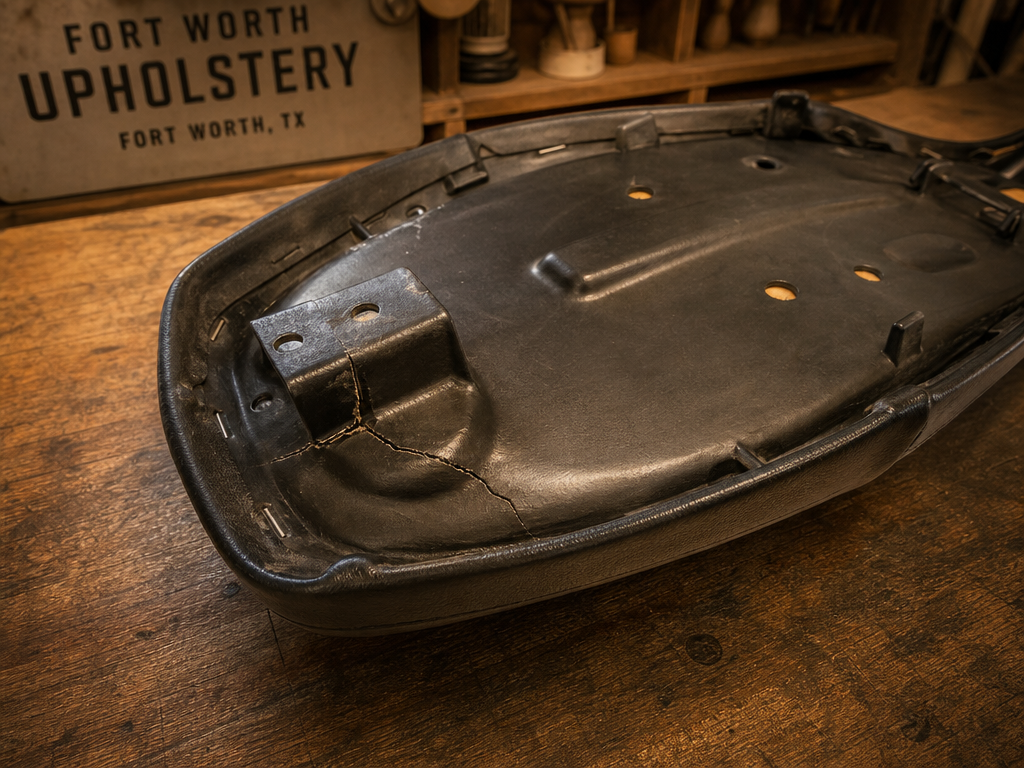
Common pan repair methods include plastic welding with 3M plastic fillers (applied after burnishing the plastic to ensure proper adhesion), metal plate reinforcement (forming a metal plate to the pan's contour and securing it with pop-rivets), and JB Weld for minor cracks where no significant flex is expected.
Important: Because seat pans are subject to constant vibration and flex, glues often fail without heavy structural reinforcement. If a mounting point is compromised, the pan is generally non-repairable. Don't trust a mounting point that has been patched over — if it fails at speed, the consequences are serious.
Upholstery Thread: Type, Size, and Stretch Control
In the North Texas heat, the thread is the most common point of seam failure. Selecting the correct fiber is critical for durability.
Fiber Type: Bonded Polyester vs. Bonded Nylon
While both have high strength, Bonded Polyester (Sunguard) is the standard for DFW because it is UV-treated. Furthermore, Polyester offers excellent stretch control, whereas Nylon provides stretch and flexibility. For heavyweight cruiser seats, stretch control is preferred to prevent seams from elongating under the rider's weight.
Standard embroidery thread is not UV protected and will fade. It must be treated with Scotch Guard to extend its color life — and even then, it is best reserved for decorative elements rather than structural seams.
Tex Sizing
| Tex Size | Use Case |
|---|---|
| Tex 70 | Standard for light automotive work |
| Tex 90 (B92) | Heavy-duty cruiser saddles — preferred strength |
| Tex 135 (B138) | Superior strength and visible top-stitching on premium builds |
Vinyl Stretch Profiles: Avoiding Wrinkles
The "fit" of a seat depends on how the vinyl handles the complex contours of a cruiser pan. Using the wrong stretch profile results in permanent wrinkles that cannot be corrected after installation.
Best for contoured pans
360° (Allsport)
Equal stretch on the warp, weft, and bias. This is the gold standard for high-performance motorcycle seating with deep tapers — allows the material to conform to complex curves without tension points.
Flexible all-rounder
4-Way (EverSoft)
Provides a balance of flexibility and structure; good for corners but maintains a leather-like grain. Suitable for most standard cruiser seat profiles.
Flat surfaces only
2-Way (Construction)
Only for flat box cushions. Using this on a contoured cruiser seat will result in sagging because it cannot be tensioned properly around curves.
The Truth About Leather vs. Vinyl in Texas
Marine-grade vinyl is highly weather-resistant and requires lower maintenance. If choosing leather, only automotive-grade hides should be used. Leather is a skin that requires cleaning and conditioning every 3–6 months to prevent it from drying out in the DFW heat.
From a cost perspective, leather is significantly more expensive because it is sold by the hide (typically 50–60 sq. ft.). Because of natural imperfections like scars and brands, there is a high percentage of waste when cutting a seat pattern, which increases the material cost by 150–300% over vinyl. For high-mileage DFW touring, riders should also prioritize a high double rub count — an industry measure of abrasion resistance — when selecting any material.
Mechanical Integrity: Gold Wing and Touring Backrests
Backrest upholstery is more than just fabric; it involves mechanical maintenance of the mounting hardware. During a professional rebuild, the following components must be inspected:
Mounting Bracket and T-Nuts
We utilize 1/4-20 T-Nuts and socket head cap screws to secure the bracket to the seat pan. Corroded or stripped T-Nuts are a common hidden failure point that only reveals itself during teardown.
Spring Plunger (Height Adjustment)
This allows for height adjustment. A common technical error is over-tightening the Spring Plunger, which causes the backrest to bind and prevents smooth movement. It should allow free travel without play.
Seat Hole Plug
This component must be properly seated to protect the internal bracketry from the elements. A missing or cracked plug allows water infiltration directly to the mounting hardware.
Cost and Timeline Drivers
- Standard re-coverSeat size and material
- Full custom buildFoam rebuild and design
- Custom embroidery (simple skull outline)Design and stitch count
- Custom backrest embroideryDesign and stitch count
- Gel pad add-onPad size and placement
- Heated element integrationWiring and seat access
- Lead time (peak riding season)3 – 6 weeks
Call for a free quote. We price every seat after seeing what it needs.
Quote-Prep Checklist
-
Detailed Photos
Clear shots of the top, the bottom pan, and all mounting hardware. Pan damage is often invisible from the riding surface — we need to see underneath.
-
Bike Specifications
Year, make, model, and seat type (Solo vs. Touring). Different touring platforms have unique pan geometry and hardware configurations.
-
Storage and Usage
Specify if the bike is garage-kept and your average daily mileage. This helps us recommend the right foam density and material weight for your riding profile.
Common Questions
Frequently Asked Questions
Is it cheaper to reupholster or buy a new motorcycle seat?
It depends on the condition of your seat. Reupholstery gives you custom ergonomics and better foam density than you'll get from OEM, but if your seat pan is broken, buying a new OEM seat is the more practical choice, because a broken pan turns a re-cover into a structural project. Foam, pan condition, material, and add-ons all drive the cost. Call for a free quote.
How long does a professional motorcycle seat job last?
A seat built with UV-treated polyester thread and marine-grade vinyl should last 5–8 years in North Texas conditions. In high-UV environments like DFW, vinyl generally outlasts leather because leather requires consistent conditioning to stay supple — and riders don't always keep up with it.
Why is my seat squishy after rain?
This indicates the foam has soaked up water. Water has bypassed the cover — typically through a cracked or aged seam — and is now trapped in the foam core. Saturated foam will lead to mold, persistent odors, and internal rust on metal frame components if not addressed quickly.
Should I sit on custom embroidery on my seat?
It is not recommended. The friction from your riding gear will cause the threading to fray over time. Embroidery is best placed on backrest panels or side flanks — areas that receive visual attention but not direct rider-contact abrasion.
Can I add seat heat after the seat is reupholstered?
Yes — heated elements can be integrated during the rebuild, provided the shop has experience with electrical routing in the motorcycle's seat cavity. Adding heat after the fact requires fully reopening the seat. If you're considering it, tell us during the initial consultation so we can route correctly the first time.
What is the best all-weather material for a motorcycle seat?
Marine-grade vinyl. It offers superior water resistance and UV protection compared to standard textiles or leather. In DFW conditions — with the combination of UV intensity and occasional heavy rain — marine vinyl is the most practical choice for year-round durability without the maintenance burden of leather.
Motorcycle Upholstery · Fort Worth, TX
Ready for a Hands-On Consultation?
We Specialize in Touring Saddles
For DFW riders who value mechanical precision and long-distance comfort, we offer hands-on consultations at our Fort Worth facility. We specialize in structural restoration and ergonomic reshaping for Harley-Davidson, Indian, and Gold Wing touring saddles.
View Motorcycle Upholstery Services →What Our Clients Say